The Theory of Everything

It seems that the Einstein Spacetime is the key of the Theory of Everything - ToE -, or Grand Unified Theory - GUT -. Indeed, spacetime explains all phenomena of the universe: gravity, quarks, antimatter, neutrinos...

The "Spacetime Model" is a new theory, or "alternative theory", based on spacetime. However, instead of limiting it to general relativity, the author has extended spacetime to all elements of the universe: particles, mass, charge, quarks, antimatter, Standard Model, forces... Indeed, the Spacetime Model explains with logic and consistency:

  • The mystery of the wave-particle duality,
  • The location of antimatter in the universe,
  • The constitution of light and why its velocity is constant. What the photon is,
  • The charge and constitution of particles. What matter is,
  • The mechanism of waves and particles creation. Example: e-e+ annihilation producing two 511 KeV gammas and an antineutrino,
  • A logical and consistent explanation of mass and gravity,
  • The internal constitution of quarks. Origin of their charge -1/3 +2/3,
  • The extension of the Standard Model. Example: the pion decay in muon,
  • What the neutrino is,
  • The internal structure of leptons, mesons and baryons,
  • Why the charge of the proton is exactly equal (abs. value) to that of the electron,
  • The origin of the strong nuclear force,
  • The mechanism of electromagnetism,
  • The unification of the electroweak, strong nuclear and gravitational forces in two generic forces.
  • Explanations of the EPR, Young's slits, Heisenberg Uncertainly Relation, Schrödinger Probability, orbitals, quantum levels, E0 level...

This new theory clearly shows that

Einstein Spacetime is the key of the Theory of Everything, or TOE (or GUT)

The Spacetime Model solves 53 enigmas of quantum mechanics, in a logical and rational way. For example, this "alternative theory" explains why the mass of the muon (105.658 MeV) is 23 times Dm between the charged and neutral pion (4.5936 MeV), with a CL>99%. The Spacetime Model is also in perfect accordance with several experimentations, with no contradiction.

To summarize, the Spacetime Model contains many good ideas concerning the explanation of basic phenomena of quantum mechanics. The Spacetime Model probably has some errors, but the main ideas developed, which are the extension of the Einstein Spacetime Concept to quantum mechanics, are fundamentally correct.


Download information

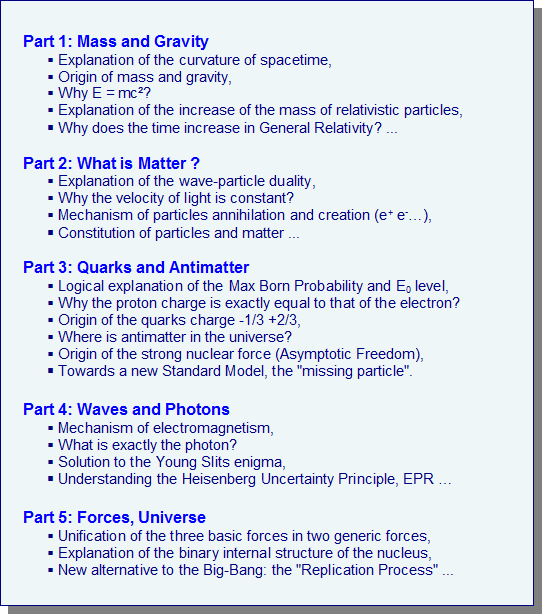
Since spacetime is difficult to understand, to improve readability, the Spacetime Model has been divided into five parts. Each section covers a particular domain of the Theory of Everything (TOE), or Grand Unified Theory (GUT).

You can download each part separately (five PDF files of 40-50 pages each). However, it is best to download the entire document (a 210 pages PDF file). The download commands are located at the end of this web page, after the conclusions.


Part 1

Wave-Particle Duality, Charge, Matter


Wave-Particle Duality

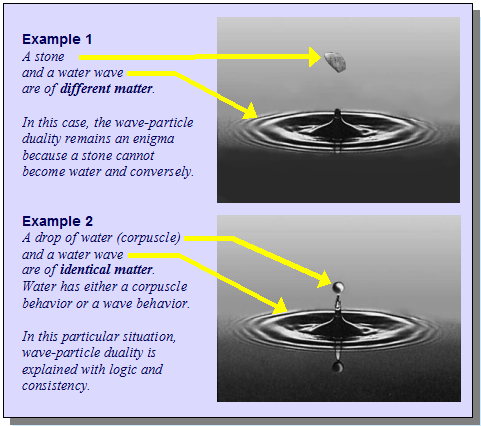
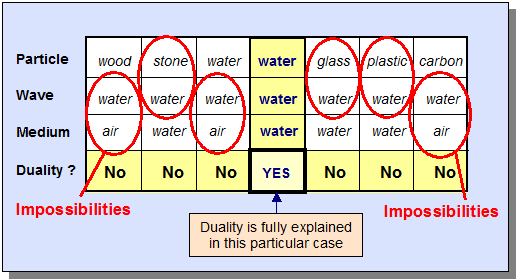
For over a century, since 1905, the wave-particle duality has remained an enigma. However, there is an exception that fully solves this mystery:

Wave-particle duality appears only in the particular situation where the wave and the particle are of the same constitution.

In this case - but only in this case -, the wave-particle duality is no longer an enigma.

On Earth, for example, the water of Niagara Falls has a corpuscular behavior during its fall and, once it has reached the river down below, the particles become "eddies", or waves. The same water is either a particle, during its fall, or a wave, in the river. This explanation is confirmed by experimentations: the particle and wave states never appear simultaneously.

Charge, Matter

The logical solving of the wave-particle duality enigma means that if we know the nature of waves, we will automatically know the nature of particles, since waves and particles have the same constitution. This enigma is solved in Part 1.


Part 2

Mass and Gravity


Mass and volume

In our world, mass and volume seem to be two different quantities because in atoms, the mass is not proportional to the volume. So, we have a large range of atoms - and objects - with different mass and volume.

However, at the particle level, mass = volume. In reality, we have two main classes of volumes:

  1. Closed volumes (A). These volumes make a displacement of spacetime. As we know, the spacetime curvature produces gravity, but it also produces a "mass effect". Electrons, nucleons, mesons, muons... are examples of closed volumes. Indeed, these particles have a mass.
  2. Open volumes (B). These volumes exist but do not produce any displacement of spacetime. If there is no curvature of spacetime, there is no "mass effect" either. Orbitals in atoms are examples of open volumes. Indeed, experimentation confirms that orbitals are massless.

Each atom has a particular proportion of open and closed volume.

This is why mass and volume seem to be two different quantities. It is an illusion. At the particle level, mass equals "closed volume", more precisely m=k.v (k = 6.256x10¹⁷ kg/m3 approximately).

Gravity

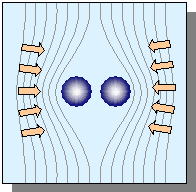
Using the "open and closed volumes" concept, the Spacetime Model demonstrates that spacetime is not curved by mass but by volume. This phenomenon is the same as when you immerse a ball into water. It is not its mass that produces the displacement of water, but its volume.

Therefore, the (closed) volume of particles - not their mass!!- makes a displacement (or curvature) of spacetime, which produces a pressure force on volumes, more exactly a Hooke Force.

This force tends to bring particles closer to each other. The result is gravity, which is not a mysterious attractive force between masses, but a simple pressure force (Hooke Force) exerted by spacetime on closed volumes.

Note: Open volumes, like orbitals, are massless and are not concerned by gravity.


Part 3

Quarks, Antimatter...

Quarks

The Spacetime Model demonstrates that we need two positrons to make three u quarks. A u quark with an electron becomes a d quark (the rule of addition of fermions is covered in Part 4). This deduction, from the wave-particle duality and spacetime, has been extended to all particles. Finally, u quarks, d quarks, antiquarks, muons, antimuons, taus, mesons etc... are made up with only two basic particles: electrons and positrons.

Antimatter

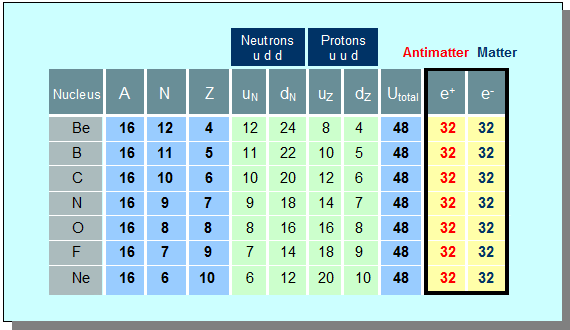
From this discovery, we can deduce that antimatter is not located at the bottom of the universe but right before our eyes, embedded in quarks. A simple calculation demonstrates that any atom is made of an equal number of electrons and positrons, exactly 2A (A = atomic number). For example, the C12 is made of 24 electrons and 24 positrons, the latter being embedded in quarks. This calculation is 100% accurate for the 2930 known isotopes.


Part 4

Electromagnetism

Explanation of the wave-particle duality mystery (Part 1) leads to a full knowledge of electromagnetism.

In short, when a charged particle is motionless, its electric field is in a spherical symmetry. When the particle moves, it becomes a wave and its spherical symmetry disappears. Its 1D space is transformed into a 2D/3D space. A magnetic component is added to the electric field (1D) of the particle. This phenomenon is identical to that of a water drop (1D spherical symmetry) which becomes a water wave (3D).

This explanation is proven by experimentation (Δq/Δt).

Note: the photon concept, Young Slits, E=mc² enigma... are explained in this part.


Part 5

Nucleus, Forces, Universe, Big-Bang...

Part 5 covers the unification of forces and miscellaneous subjects.

At the end of Part 5, a suggestion regarding the creation of the universe is given. In reality, the Big-Bang Theory does not explain the "electron mystery". This enigma is discussed in Part 5.

The Spacetime Model offers two logical suggestions regarding the creation of the universe. There may be other solutions, but the Big-Bang Theory is not fundamentally correct since it doesn't solve the "electron mystery".


Conclusions

Since 1905, some fundamental enigmas, like the wave-particle duality, have never been solved. Later, some theories were devised on this erroneous basis. Today, with more than 50 unsolved enigmas, modern physics has reached a deadlock. Indeed, no one is able to explain fundamental phenomena like charge, mass, gravity... with simplicity and consistency.

So, the author went back to the early 1900's to solve the very first enigmas of quantum mechanics, taking experimentation in account. Some highly debatable theories based on preconceived ideas were dropped. For example, positrons, which flow out of the nucleus (beta+), is the sign that antimatter may be located inside the quarks. This possibility must not be rejected. Searching antimatter in the deep universe without any good reason to do it, is one of these preconceived ideas that must dropped.

Finally, this document demonstrates that:

  1. The Theory of Everything is very simple. The basic laws of quantum mechanics are not imbedded in increasingly complex theories but, on the contrary, in simplicity.
  2. Enigmas: Other theories solve 1, 2, may be 3 enigmas. The Spacetime Model solves 53 enigmas of quantum mechanics. It is not quite by chance that this new theory solves so many enigmas without any contradiction with experimentation.
  3. The Theory of Everything needs only four dimensions. All particles like quarks, neutrinos... and all basic phenomena of the universe, like gravity, strong nuclear force... are fully described with only four dimensions: x, y, z and t. Therefore, it is not necessary to add extra dimensions as in some alternative theories.

Author: Jacky JEROME

Note: The Spacetime Model is published under the reference: ISBN 97829531234.

Last update: 25 May 2008,


Comments from physicists...

"I waited 35 years to find such elegant answers." (P.C.)

"Quantum mechanics explained in a logical fashion. Great work!!" (C.F.)

"...you've got it..."(concerning the Theory of Everything) (J.G.)

"Extraordinary simple to understand" (N.L.)

"It's interesting that while it makes sense. I like what you've done." (G.Z.)

"You have done a wonderful favor to all the seekers of truth through knowledge." (C.S.)

"Paper is very interesting!" (D.M.)

"must congratulate you on your style and simplicity" (J.C.)

"A seemingly complicated topic has been dealt with such ease and simplicity that the whole experience is enlightening." (C.S.)

"Very interesting." (B.T.)

"Please tell us more." (B.X.)

93% of the readers consider that the Spacetime Model is "very interesting".


Download commands

Download the entire document (PDF 5 Mb, V 2.61)

Vista or Adobe Reader Users: If you get a download error, click here.

This operation can take few minutes.

...or download each part separately.

Cover

Introduction

Part 1 : Duality, charge, matter

Part 2 : Mass and Gravity

Part 3 : Quarks, Antimatter...

Part 4 : Electromagnetism

Part 5 : Nucleus, Forces, Universe, Big-Bang...

Table of contents

The entire document can also be downloaded on Google Books

Other Author's Websites:

www.wave-particle-duality.com

www.mass-gravity.com

www.higgs-boson.org


Spacetime Model: Table of contents

Part 1: Wave-Particle Duality, Charge and Matter

  • Wave-Particle Duality
  • Spacetime
  • Movements in Spacetime
  • Forces in Spacetime
  • Electron-Positron Annihilation
  • Nature of Particles
  • Clarification

Part 2: Mass and Gravity

  • Mass
  • Open and closed volumes
  • Gravity

Part 3: Quarks, Antimatter, Nuclear Force

  • The Distributed Charge Model
  • µDomains
  • U and d Quarks
  • Antimatter
  • Nucleons
  • Interactions
  • The Standard Model

Part 4: Electromagnetism

  • Electromagnetic Radiations
  • Electromagnetism
  • The Photon
  • Waves

Part 5: Nucleus, Forces, Universe, Big-Bang

  • Atom
  • Nucleus
  • Quarks and Mesons
  • Radioactivity
  • Forces
  • The Universe
  • Conclusions
  • Alternative theories


Note: You can also access this site using the following URLs: www.spacetime-model.comwww.grand-theory.com, www.grand-unified-theory.com, www.wave-particle-duality.com, www.mass-gravity.com and www.higgs-boson.org.

Powered by WebRing.